
Goldilocks Zone in the Sky
Researchers
Sara Seager
Lead researcher
Host(s)
Paul Dalba
Science communicator
The Goldilocks Zone in the Sky
Venus may be a planetary cautionary tale, but its plot has an unexpected twist. Despite the hell that lies below, there is a tiny slice of atmosphere where conditions become nearly normal by Earth standards. Temperatures and pressures in this "aerial biosphere" are surprisingly pleasant. This region, known as the "Goldilocks zone" in Venus's atmosphere, has brought up a fascinating question among scientists: could life exist not on the planet's surface, but well above it?
Venus's thick cloud cover extends from roughly 45 to 70 kilometers (~28 to 45 miles) in altitude, but it is not so uniform. According to measurements by R. Knollenberg and colleagues (1980, 1982), these clouds are divided into three main layers, each containing droplets of different sizes and chemical compositions.
The upper cloud layer, extending from about 56.5 to 70 kilometers, is composed primarily of tiny droplets containing roughly 80% sulfuric acid (H2SO4) and 20% water. These particles are extremely small, typically less than a micron in size, and are classified as Mode 1 particles, with a mean diameter of about 0.4 micrometers.
Below this sits the middle cloud layer, roughly from 50.5 to 56.5 kilometers. Here, the droplets grow somewhat larger and are composed of approximately 90% sulfuric acid and 10% water. These droplets correspond mainly to Mode 2 particles, which have diameters of a few micrometers up to 7 micrometers.
The lower cloud layer, from about 47.5 to 50.5 kilometers, is the densest and most chemically concentrated. Droplets here contain up to 98% sulfuric acid and only about 2% water, sometimes forming what chemists call fuming sulfuric acid, a mixture of H2SO4 and dissolved SO3. In this region, scientists also detect much larger particles, Mode 3 droplets, exceeding 7 micrometers in diameter. Intriguingly, the exact composition of these large particles remains unknown.
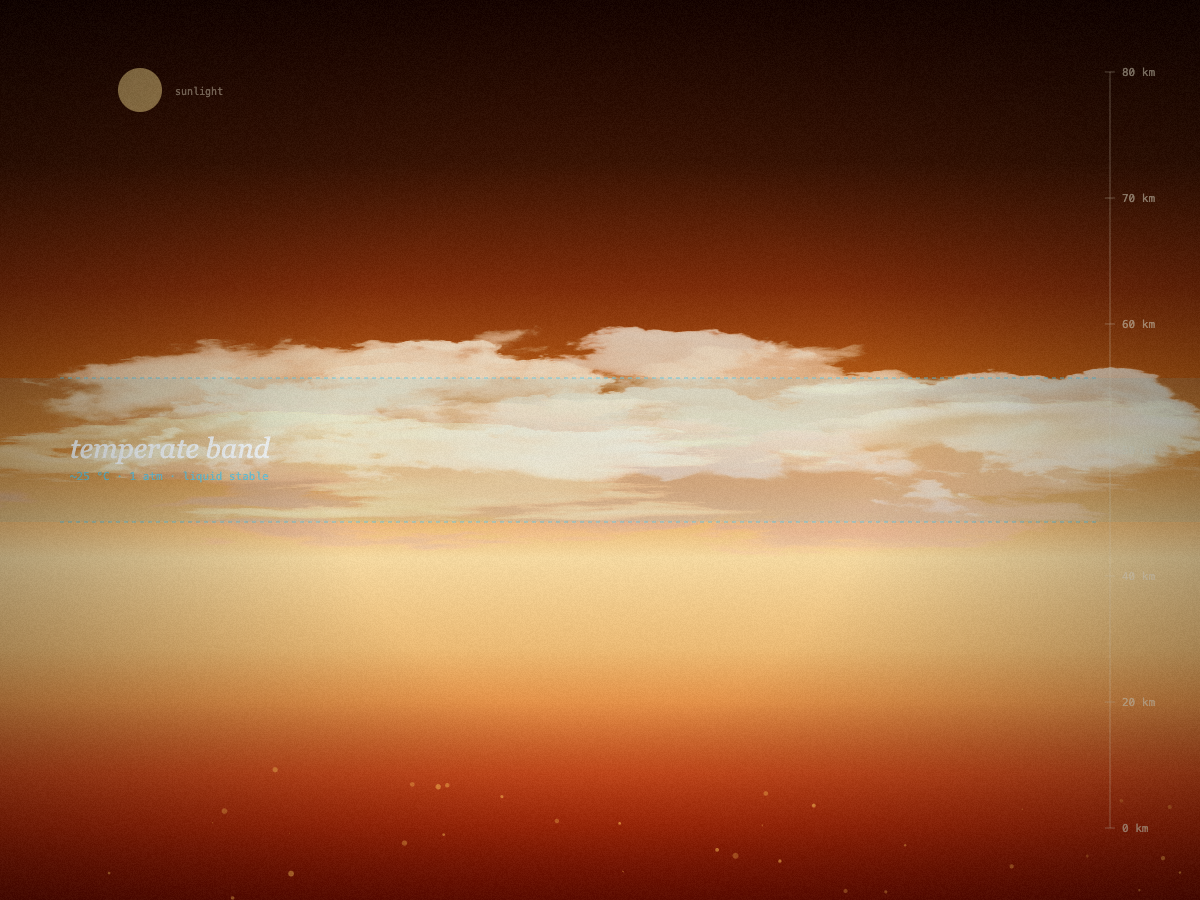
When considering temperatures and pressures, the lower to middle layers of the atmosphere, roughly between 48 kilometers and 60 kilometers above the surface, are more suitable for life. While the temperatures here range from 0 to around 60 degree celsius, the pressure is around 1 atmospheric pressure, similar to on Earth. Above 60 kilometers, temperatures gradually decline, eventually dropping below freezing in the upper cloud layer. Conversely, below 48 kilometers, temperatures rise rapidly. As a result, these regions are less hospitable for life as we know it.
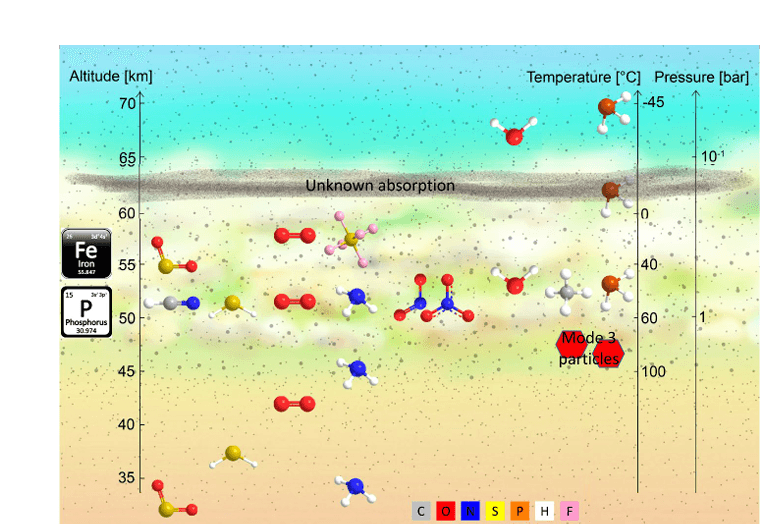
Credit: Petkowski et al. (2023)
Another aspect of Venus that adds to the intrigue is its rotation. The planet rotates slowly, taking about 243 days to spin once around its axis. And it takes about 225 days to complete one revolution around the sun. The cloud tops, however, are very different. They exhibit something called the "super-rotation," spinning once every 4 days or roughly 96 hours. Measurements have shown that windspeeds in the cloud deck are close to 100 m/s, and that is 40m/s to 60 m/s relative to the ground.
The super-rotation is churning up the clouds and mixing everything across the cloud layers. Similarly, vertical transport occurring through turbulent mixing, convection, and gravity waves would make sure the particles and trace gases are frequently exchanged between different regions of the cloud layer. If any microorganisms were to exist within these droplets, they would not inhabit a stable location. Instead, they would be carried around the planet and cycled through regions with slightly different temperatures, pressures, and chemical compositions.
This circulation is particularly important when considering the lifetime of cloud particles. Droplets in Venus's atmosphere grow over time through condensation and coagulation. As they increase in size, gravity begins to pull them downward. For example, according to Bains et al (2021), an 8 μm Mode 3 particle has an estimated settling velocity of roughly 3 x 10⁻3 m/s under Venusian cloud conditions. Over the course of a Venusian night (when sunlight is absent), such a particle could drift downward by 750 meters.
However, Venus's fast-moving atmosphere may help prevent these particles from falling too far. Because the clouds circle the planet in about four to five days, droplets experience shorter cycles of daylight and darkness compared to if the atmosphere were locked to the surface. This is important because a process called photophoresis, where sunlight can push tiny particles upward in a gas, only works when sunlight is present. During the night, droplets slowly sink under gravity, but when sunlight returns, photophoresis pushes them upward again. Over many cycles of day and night, this balance could help keep cloud particles floating within the temperate cloud layer.
Another intriguing feature of Venus's clouds is the presence of an unknown ultraviolet (UV) absorber. When scientists began observing the planet in ultraviolet light in the 1920s, they noticed dark and bright patterns across the clouds. These patterns move around the planet along with the fast four-day superrotation of the upper cloud layer, but they also change shape and position over time.
Scientists believe these patterns are caused by some substance in the atmosphere that absorbs sunlight between 320 and 400 nanometers. Despite many studies, no single chemical has been able to fully explain the observations. Because of this, researchers often call it the "unknown UV absorber." Therefore, this interesting cloud deck seems to have all the ingredients to host life: a liquid environment, moderate temperatures, an energy source, and chemical elements important for life.
Venus's clouds or its "aerial biosphere" satisfy some of the minimum criteria for potential habitability, making it a clear target for continued astrobiological investigation.
Comments
Be the first to comment.
In the last episode, we explored a haunting possibility — that ancient Venus had oceans, a temperate climate, maybe even life. And then it all transformed into the hell we see today. But if life emerged during those billions of habitable years, where did it go?
Because there's one place on Venus that remains habitable, even now, even after everything. The clouds.
Today we're heading somewhere unexpected — to the one region of Venus where the temperature is comfortable, the pressure is normal, and the conditions might actually support life.
Let me take you on a journey upward from Venus's surface. We start at ground level — seven-hundred-and-thirty-five Kelvin, hot enough to melt lead, crushing pressure ninety-three times Earth's sea level, utterly inhospitable. But as we rise through the thick atmosphere, something remarkable happens. The temperature drops. The pressure eases.
Between forty-eight and sixty kilometers altitude, we enter what might be the most extraordinary environment in the solar system — the main cloud deck. Temperatures from zero to sixty degrees Celsius, pressure of one atmosphere. Exactly Earth's sea level. Well — apart from the clouds being made of sulfuric acid.
When we say a planet is habitable or uninhabitable, we're actually being pretty imprecise. Habitability isn't about the planet as a whole — it's about specific environments within that planet.
The cloud particles come in different sizes, which scientists call modes. Mode 1 are tiny, about zero-point-four micrometers. Mode 2 are a few micrometers across. And then there are the mysterious Mode 3 particles — more than seven micrometers, sometimes much larger, and possibly not spherical.
Venus rotates incredibly slowly — one Venusian day is two-hundred-and-forty-three Earth days, slower than its year around the sun. But the clouds — the clouds race around the planet in just ninety-six hours. Wind speeds in the upper clouds reach about one-hundred meters per second, or three-hundred-and-sixty kilometers per hour.
What makes Venus's clouds even more remarkable is that they're photochemical — not driven by simple condensation, like Earth's water cycle. It's photochemistry above, thermodynamics below, and the clouds exist in between.
I find that deeply satisfying. The clouds aren't there by accident — they're there because that's where the physics and chemistry demand that they be. And the fact that this location just happens to have temperatures and pressures compatible with life — that's either an extraordinary coincidence, or a hint that we should be paying very close attention.
Recent research suggests that at least some of the cloud particles might be partially neutralized by ammonia or other bases — making them less acidic than pure sulfuric acid.
Venus's atmosphere has carbon dioxide in abundance. Sulfur compounds everywhere. Trace amounts of water vapor, nitrogen, and potentially phosphorus-containing compounds. So yes — remarkably, the cloud layer has the basic requirements.
If you're a microbe on ancient Venus and your ocean is slowly evaporating away, the clouds are the only place left to go.
In the next episode, Earth's Aerial Biosphere, we'll look up at our own planet's clouds. We'll meet the bacteria and fungi that live in Earth's atmosphere — because if we want to know whether life can exist in Venus's clouds, we should probably start by understanding the life that already exists in Earth's.