
Whispers from the Archive
Researchers
Sara Seager
Lead researcher
Host(s)
Paul Dalba
Science communicator
The Pioneer Venus probes flew through the cloud deck in 1978. The data they returned is still on tape, still being re-analyzed, and still surprising. This episode is about what fifty-year-old measurements are telling us now — and why some of them point to chemistry our models cannot explain.
Comments
Be the first to comment.
It's December 9th, 1978. A small metal capsule, about the size of a compact car, is falling through the clouds of Venus.
Then, at around fifty kilometers altitude, something clogs the inlet — a droplet of sulfuric acid from the clouds has found its way into the tube.
And then, for nearly fifty years, most of those data points are never looked at again. Not because they weren't worth looking at — but because no one thought to ask the right question.
The Venus atmosphere, in their understanding, was at chemical equilibrium. That assumption was baked into the mission design — into what they considered significant, and what they filed away as unremarkable.
Rakesh Mogul at the California State Polytechnic University in Pomona decides to go back and look very carefully — not the parts everyone has already looked at, but the parts nobody had really dug into.
The key action happened at around mass thirty-four. Now, mass thirty-four can correspond to two molecules — hydrogen sulfide or phosphine. The difference is less than a hundredth of an AMU.
Their best fit suggested the signal at mass thirty-four was roughly eighty-two percent phosphine and eighteen percent hydrogen sulfide.
A tentative detection of phosphine at roughly point-one to two parts per billion at fifty-one-point-three kilometers altitude — right in the middle of Venus's cloud deck.
Our archives are treasure troves. Locked inside numbers nobody had really scrutinized was independent evidence of exactly the molecule a team of astronomers were fighting about with modern telescopes nearly fifty years later.
These molecules taken together represent what chemists call redox disequilibrium — reducing compounds like phosphine or hydrogen sulfide coexisting with the oxidizing sulfuric acid environment of the Venus clouds.
The most dangerous assumption in science isn't a wrong number. It's a framework so embedded that you stop seeing evidence that challenges it.
Both detections are consistent with each other in a way that's hard to explain by coincidence — they paint a picture of an atmosphere doing something unusual at precisely the altitudes where life has been proposed to live.
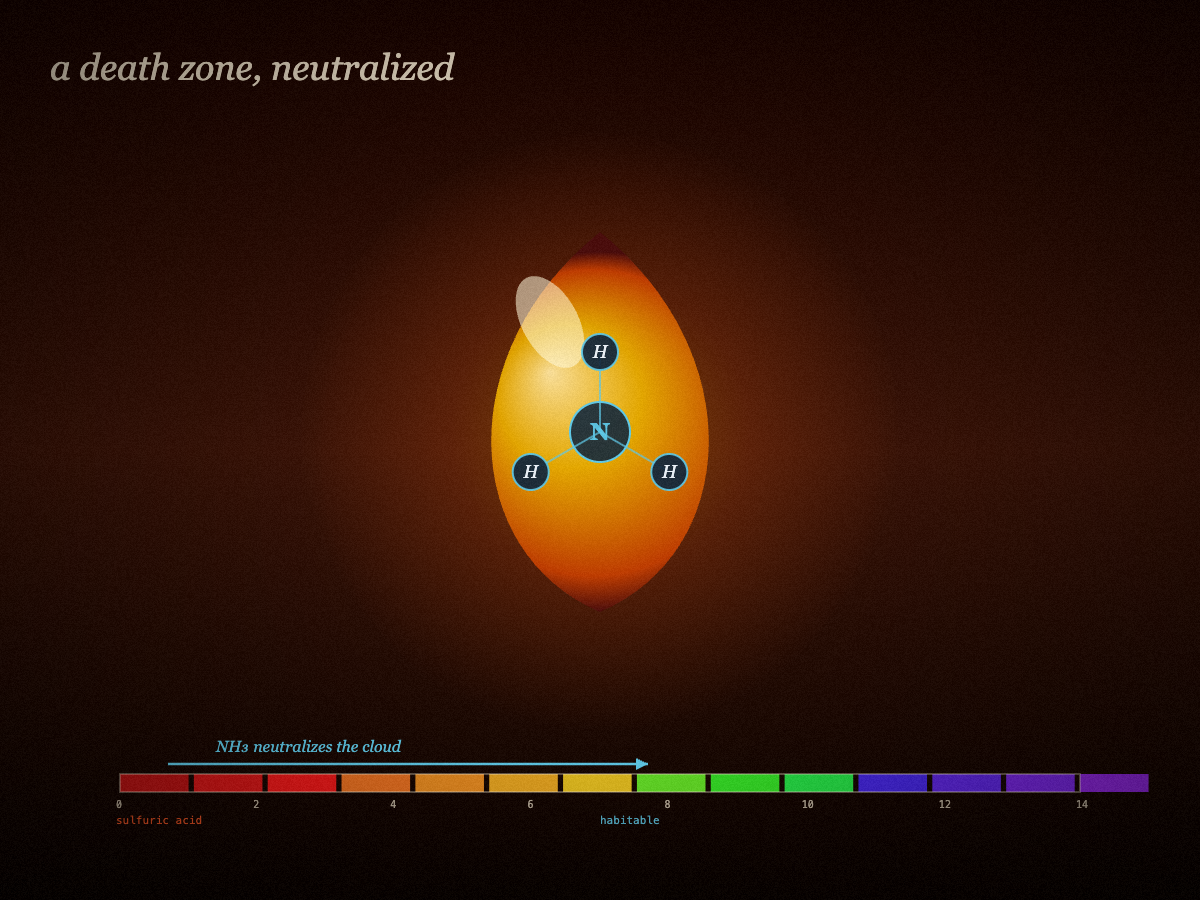
That molecule is ammonia — and if the current hypothesis is correct, it suggests that life might be actively remodeling its own chemical environment.