
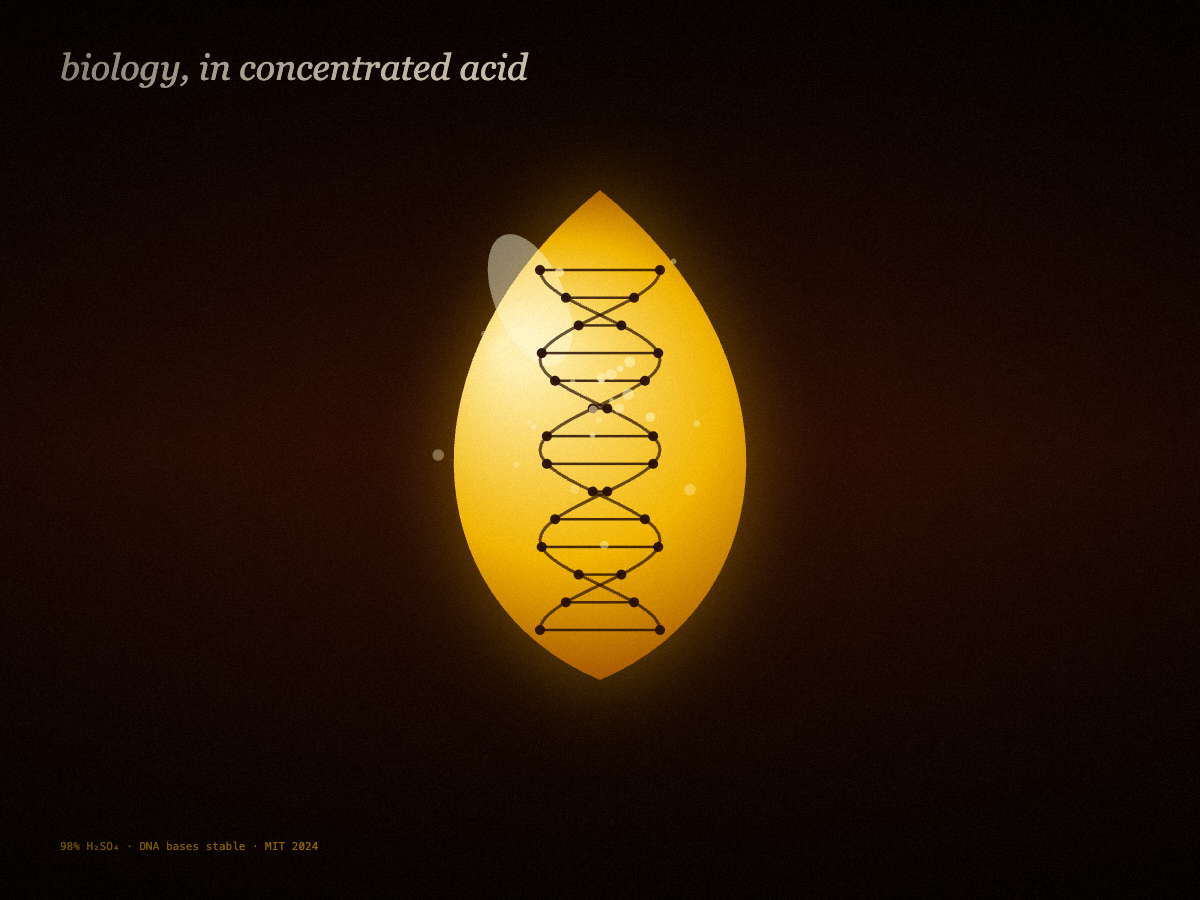
Molecules That Shouldn't Survive
Researchers
Sara Seager
Lead researcher
Host(s)
Paul Dalba
Science communicator
For two decades, the consensus was that complex organics like nucleic-acid bases and amino acids could not persist in 95% sulfuric acid. The Seager group's lab work, with Petkowski and Bains, has been quietly inverting that consensus. This episode is about the specific molecules that survive — and what that means for whether the Morningstar missions can find them.
Comments
Be the first to comment.
Picture a lab bench at MIT. Not the glamorous version of science you see in movies — there are no sparkling Tesla coils, no glowing centrifuges. Just old benches, glassware, reagents, instruments. A researcher takes a small vial of concentrated sulfuric acid — the same stuff that's inside the clouds of Venus — and carefully dissolves a tiny amount of powder into it. The powder is adenine.
And then they wait. A day passes — the vial sits on the bench, they analyze it. Nothing has changed. A week passes — they analyze it again, still nothing. Two weeks — the adenine is just sitting there. In concentrated sulfuric acid, completely intact. The scientific community thought this shouldn't be possible. But that consensus paradigm was wrong.
I'm Paul Dalba, an astrophysicist dedicated to sharing the mysteries of worlds beyond our own. While some researchers were studying telescope data and mining old archives, yet another group was asking a more fundamental question — not is there life in Venus's clouds, not even could life survive in Venus's clouds, but can the chemistry that matters for life even exist there?
Let's go back to something we established in a previous episode, the acid challenge. The clouds of Venus aren't just acidic in the way that battery acid is acidic. They are concentrated sulfuric acid — seventy-five to ninety-eight percent by weight, depending on where you are in the cloud layer. Some terrestrial biochemicals are reported to have half-lives of less than a second in these conditions. One second, and they're gone.
In twenty-twenty-three, a team led by Sarah Seager at MIT published a paper that directly challenged that assumption. They tested eight compounds — adenine, cytosine, guanine, thymine, and uracil, the five canonical nucleic acid bases, plus purine and pyrimidine, the core ring structures, and lastly two-six-diaminopurine, a genetic base substitute found in certain specialized viruses.
The result? Ring structures intact. Carbon frameworks unchanged. The bonding topology — the way the heavy atoms connect to each other — preserved across the full two-week period. No detectable reactivity. No degradation. Remarkably, in concentrated sulfuric acid at Venus cloud conditions, the building blocks of DNA just sat there.
I have to stop here for a second, because I think there's something genuinely profound buried in what might seem like an anticlimactic result. In science, we tend to celebrate the discovery of things happening — the flash, the signal, the reaction, the detection. But sometimes the most important result is the absence of an event. When those researchers ran their NMR spectra at two weeks and saw the same peaks they'd seen on day one, that was a moment — not a loud moment, not a photogenic one, but a moment where a door that everyone assumed was closed turned out to be open.
Now let me be careful here, because the Seager et al. paper itself is careful. The stability result is for the nucleic acid bases specifically. The full DNA or RNA molecule is not stable in concentrated sulfuric acid. The phosphate sugar backbone — the structural scaffold that links the bases together — would not survive. So you couldn't drop a strand of DNA in Venus's clouds and expect it to be intact two weeks later. That's not what this experiment shows.
There's an important follow-up to mention. They extended the incubation period — not days, not weeks, but a full year in concentrated sulfuric acid, and the result held, still stable. Other teams have expanded the test. Amino acids — all twenty that life on Earth uses universally. Nineteen of the twenty were either completely unreactive or only modified in a side chain, with the core backbone structure intact.
And then the lipids — the molecules that form cell membranes. When tested in concentrated sulfuric acid, some lipids self-assembled into higher-order structures, the kind of arrangements associated with membranes and vesicles. Three fundamental categories of biological molecules, all showing meaningful stability in the solvent that was supposed to make life in Venus's clouds impossible.
What the Seager et al. twenty-twenty-three paper is really getting at is not, could Earth's life exist on Venus — obviously not. It's, could the functional logic of life — information, replication, heredity — be instantiated in a chemically different system using concentrated sulfuric acid as its medium? Now we know that the building blocks can survive. The scaffold is still missing. The replication chemistry is still missing. The metabolism is still missing. But the letters are there.
That doesn't mean life exists on Venus. Let me be loud and clear about that. This is proof of possibility, not proof of existence. But in science, proof of possibility is how you decide where to point your next experiment, your next spacecraft, your next question. And right now, the Venus clouds are pointing right back.
Letters aren't a book though. Stable molecules aren't a living system. So in our next episode, the droplet life cycle, we're going to follow researchers who didn't stop at molecules. They asked — if life exists in the Venusian clouds, what would its daily existence actually look like? Thanks for joining me. I'm Paul Dalba, and this is the Morningstar Missions to Venus.