
The Phosphine Bombshell
Researchers
Sara Seager
Lead researcher
Host(s)
Paul Dalba
Science communicator
In September 2020, a small team announced that they had found phosphine — a gas associated with life on Earth — in the clouds of Venus. The detection was contested almost immediately, and the controversy has not resolved. Here is what actually happened, and why the question is more open than the press coverage suggested.
Comments
Be the first to comment.
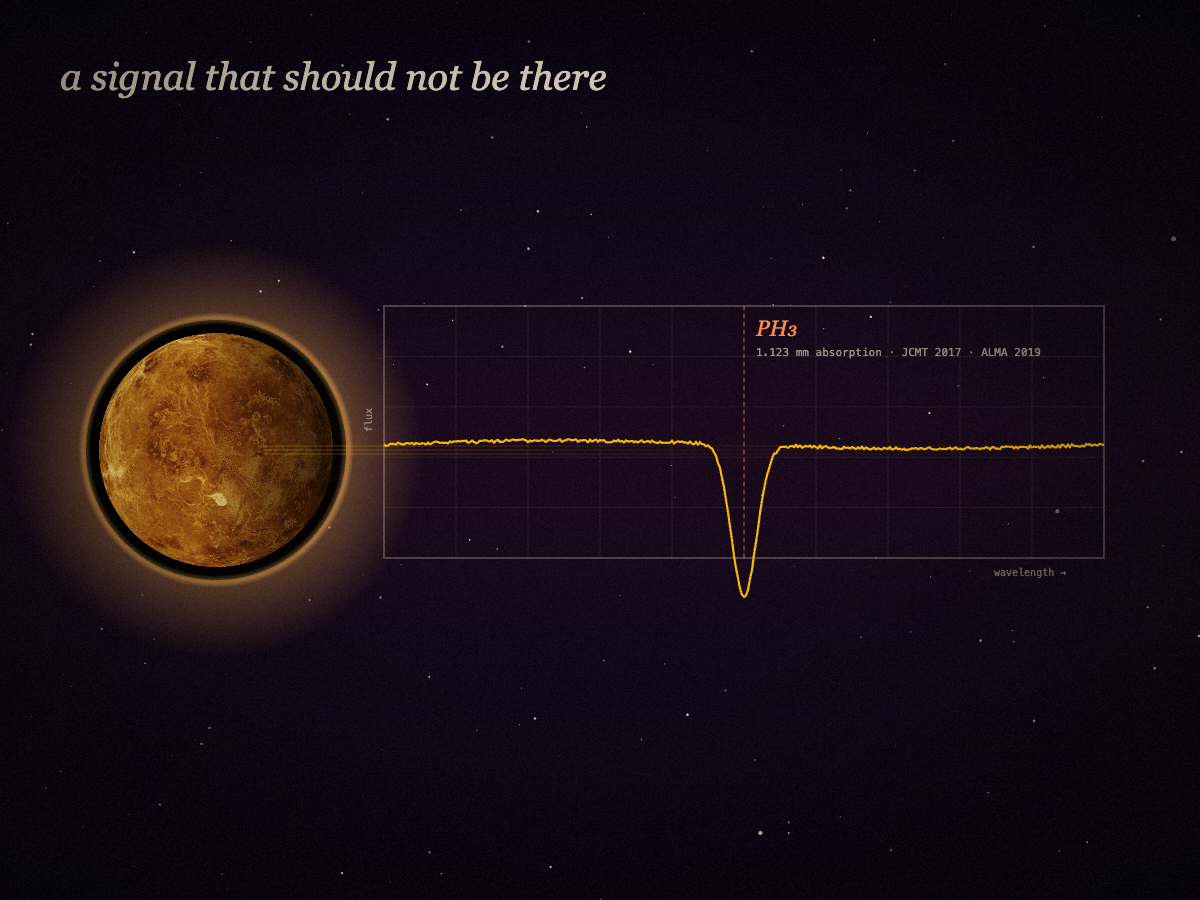
Picture a radio telescope dish, one of the largest in the world, pointed at Venus on a cold, quiet night in 2017.
A faint dip in the spectrum, at exactly the wavelength where phosphine absorbs radio waves. She thinks — hmm, that can't be right.
Same signal. And that's where things got very interesting. And very messy.
In September 2020, a team of astronomers published a paper that stopped the planetary science community in its tracks.
On a rocky planet with an oxidizing atmosphere like Earth or Venus, phosphine is chemically unstable — it reacts and gets destroyed almost immediately.
They observed Venus again, and they got the signal again, at five to seven sigma confidence. That's not a whisper, that's a shout.
Every known pathway to produce phosphine without life — volcanism, surface chemistry, lightning, photochemistry — they couldn't get anywhere near one part per billion. Not even close.
Some critics questioned whether the team was credible at all — not because of the data, but because of who the authors were.
Their primary conclusion, which was also the title of their 2021 paper, says it all. Phosphine on Venus cannot be explained by conventional processes.
And the scrutiny cuts both ways. Take the SOFIA Airborne Observatory — same data, two different conclusions, and no clear way yet to know which analysis was right.
The phosphine story has elements of all of this. Not enough to declare victory, but enough to send a probe. And that's exactly what's happening.
In our next episode, we're going back in time into a nearly 50-year-old data archive — because the clouds of Venus may have been trying to tell us something for almost half a century.
Thanks for joining me. I'm Paul Dalba, and this is the Morningstar Missions to Venus.