
The Ammonia Connection and Mode 3
Researchers
Sara Seager
Lead researcher
Host(s)
Paul Dalba
Science communicator
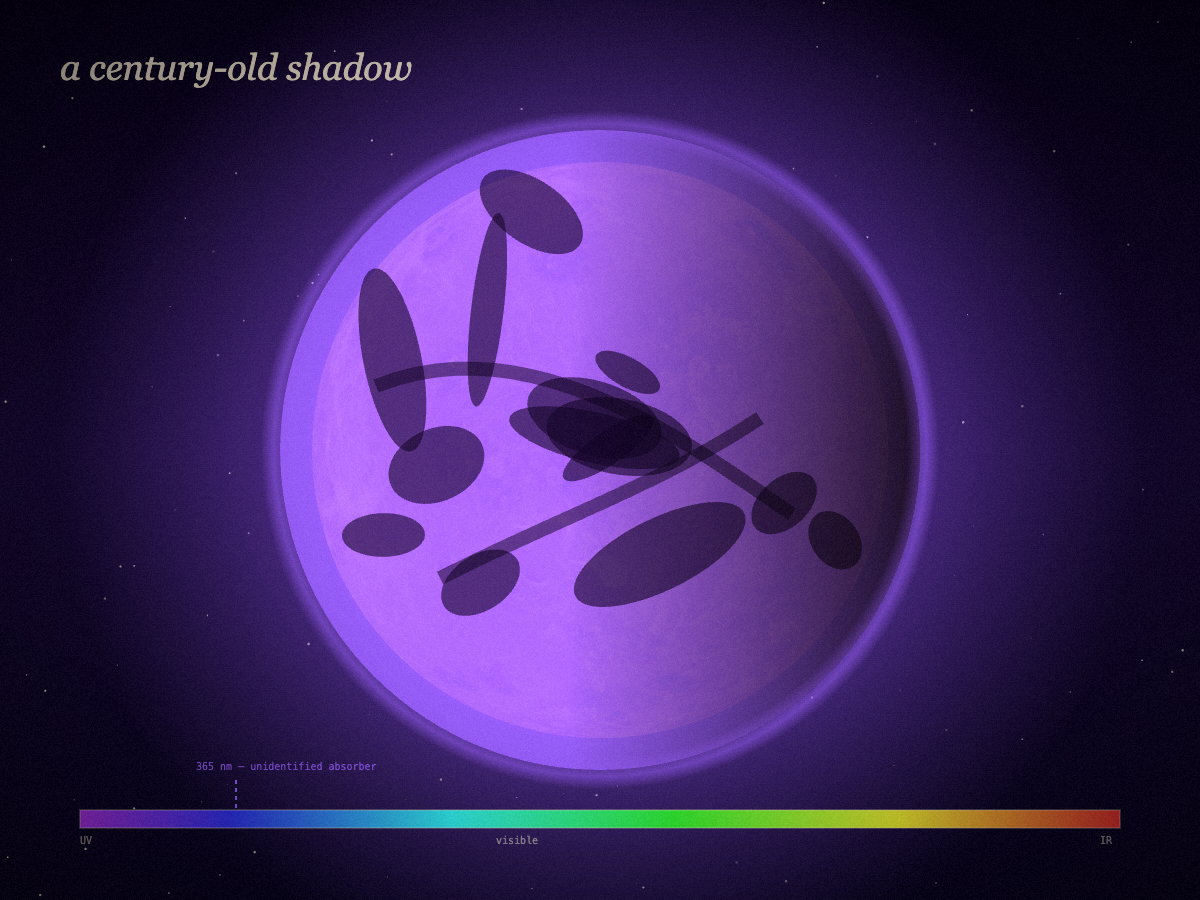
Three populations of cloud particles, two of them well-understood, one of them — Mode 3 — stubbornly not. Recent theoretical work suggests Mode 3 may be aspherical, may not be sulfuric acid at all, and may involve ammonia chemistry that, on Earth, only living systems produce.
Comments
Be the first to comment.
Once again, we begin our story with a probe plummeting through the Venusian atmosphere. This time, it's July 1972, and a Soviet spacecraft called Venera-8 is falling through the clouds.
Somewhere between thirty and forty-five kilometers altitude, the indicator changes color. The scientists back home interpret it as a detection of ammonia — between one-hundred and one-thousand parts per million. That's not a trace signal — that is a screaming detection.
The high ammonia mixing ratios reported by Venera-8 appear to be inconsistent with the observed abundances of other gases in the Venus atmosphere. In other words — ammonia doesn't fit our model, so it probably isn't there.
And for the next fifty years, that dismissal stood.
Two separate spacecraft, two separate instruments, two separate detections — both suggesting ammonia, both suppressed by the same assumption. That's not a conspiracy — that's just how consensus operates.
The question isn't, how do we explain away the ammonia detection? The question is — what if the ammonia is real? What does that mean?
What if ammonia is reacting with the sulfuric acid, pulling the acidity of some droplets all the way up to a pH of zero or one — the range where extreme life on Earth actually survives.
What makes this model genuinely compelling is that it's not just explaining one thing. It's a cool cascade — explaining several unexplained observations simultaneously.
If Mode 3 particles were concentrated sulfuric acid, they'd be round. But they're not. Ammonia reacting with sulfuric acid produces semi-solid ammonium salts — and a semi-solid slurry won't form a perfect sphere.
Phosphine and ammonia are siblings in a very specific way. In the relatively gentle thermal conditions of Venus clouds, neither should form in significant quantities by any known geological or photochemical process. But apparently something is making them.
Both anomalies are simultaneously difficult to explain abiotically and are consistent with biology. It's not proof — they're careful to say that — but it's a pattern that deserves serious attention.
This is not fringe science anymore. It is the frontier of our understanding — and that shift matters enormously, because the question of whether life exists beyond Earth is arguably the most important question the human species has ever asked.
In our next episode, Molecules That Shouldn't Survive, we go into the lab where researchers have been dissolving nucleic acid bases of DNA and RNA directly into concentrated sulfuric acid. What happened in those test tubes was not what the textbooks predicted.
Thanks for joining me. I'm Paul Dalba, and this is the Morningstar Missions to Venus.