
Paradise Lost
Researchers
Sara Seager
Lead researcher
Host(s)
Paul Dalba
Science communicator
A Paradise Lost
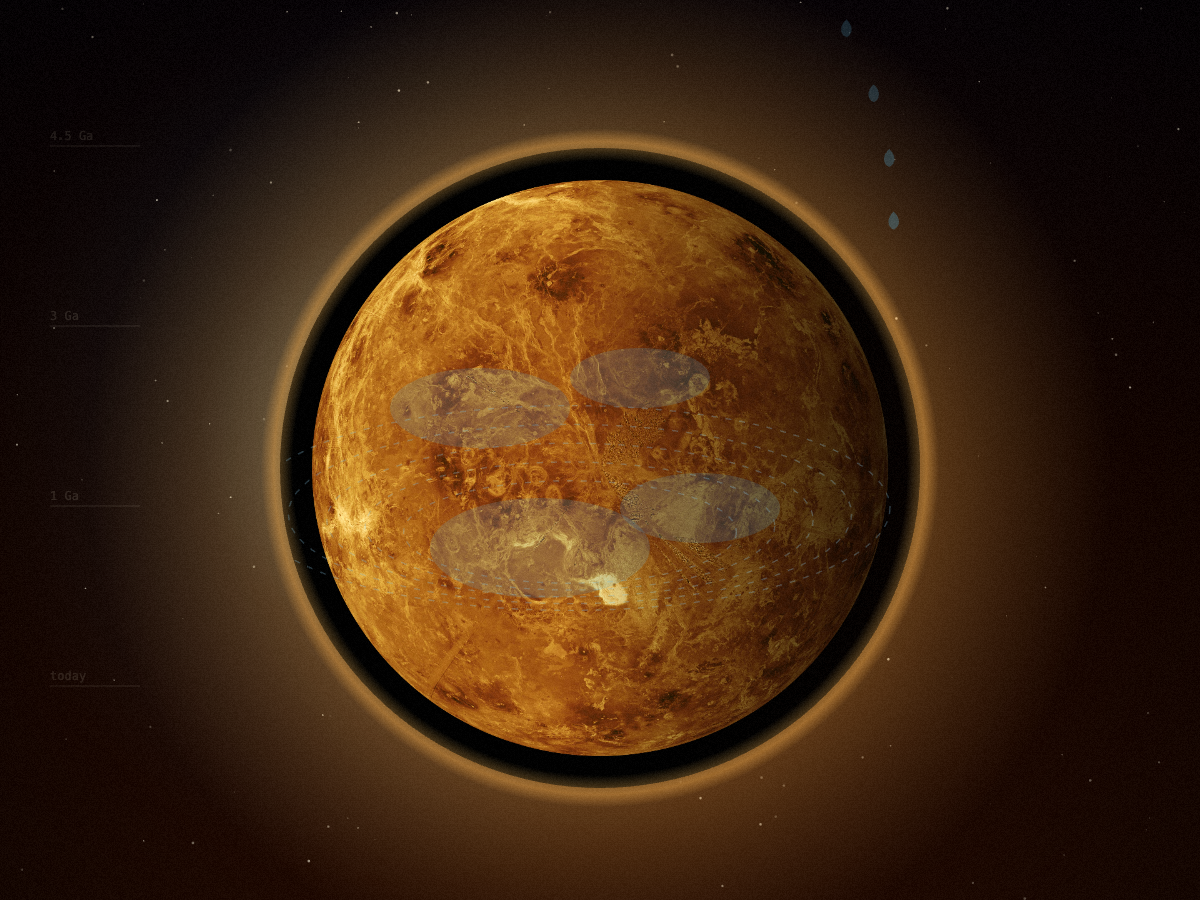
Planetary scientists are haunted by a single question: How did Venus, a planet so similar to our own, become a hellscape where lead melts on the surface and sulfuric acid rains from the sky? How Earth's twin became so different may be explained by its atmospheric history, a story told by atoms.
The key clue lies in an unusual kind of water: heavy water.
Normal water is made of two hydrogen atoms and one oxygen atom. But sometimes, hydrogen comes in a heavier form called deuterium, containing an extra neutron. When deuterium bonds with oxygen, it forms heavy water. On Venus, the ratio of deuterium to hydrogen, known as the D/H ratio, is astonishingly high. Measurements show that Venus's atmosphere has about 120-150 times more deuterium relative to hydrogen than Earth does.
This imbalance tells a powerful story. Lightweight hydrogen escapes into space more easily than heavier deuterium. This occurs through a thermal escape mechanism called Jeans escape. Because atomic hydrogen is lighter, it has a higher average thermal velocity at a given atmospheric temperature and is more likely to populate the high-velocity tail of the Maxwell-Boltzmann distribution. As a result, hydrogen atoms more frequently exceed Venus's escape velocity and are lost to space, while the heavier deuterium atoms remain gravitationally bound. Over geological timescales, this preferential loss of hydrogen enriches the remaining atmosphere in deuterium, leaving behind the elevated D/H ratio observed today.
So when scientists see an atmosphere enriched in deuterium, it's a sign that vast amounts of ordinary water were once present and then lost. According to models, Venus may have had enough water to cover its surface in shallow oceans, possibly persisting for up to three billion years, though estimates vary depending on assumptions about volcanic activity and solar output.
So what happened?
As the young Sun gradually brightened, Venus absorbed more energy than it could release. Water vapor, a potent greenhouse gas, began accumulating in the atmosphere, trapping even more heat. This triggered a runaway greenhouse effect, a feedback loop in which warming led to more water vapor, which in turn led to more warming. Eventually, the oceans boiled away entirely. Ultraviolet radiation split water molecules apart, causing hydrogen to escape into space, while oxygen either reacted with surface rocks or was lost as well.
Unlike Earth, Venus lacks a recycling system. Earth's plate tectonics acts like a planetary thermostat, burying carbon and releasing it over geological timescales. Venus, with its stagnant crust, has no such safety valve. Heat and gases built up relentlessly, and the surface was repeatedly resurfaced in vast eruptions, pushing the planet further toward extremes.
According to some models, Venus had crossed a point of no return by around 700-750 million years ago.
Yet Venus is not uniformly hellish. Paradoxically, the most Earth-like conditions on Venus exist 48 to 60 kilometers (30 to 37 miles) above the surface, high in the cloud layers. Here, temperatures range between 0 and 60 degrees Celsius, and pressure is surprisingly close to what humans experience at sea level on Earth. It's a narrow, floating zone between paradise and hell, where some scientists have even speculated about the possibility of microbial life.
Venus reminds us that planetary habitability is fragile. A small difference in distance from the Sun, a slight shift in atmospheric chemistry, and a world can tip from blue to barren. Earth and Venus may have started with similar ingredients, but they followed radically different recipes.
Comments
Be the first to comment.
Last time, we discovered the hellish reality of modern Venus. Surface temperatures hot enough to melt lead, atmospheric pressure that could crush a submarine, clouds made of sulfuric acid.
But here's the thing about hell. Sometimes it's a recent development. Sometimes — paradise came first.
So let's talk about how we know Venus wasn't always hell. And I mean know — not speculate, not guess, but actually know based on measurements. The evidence is written in atoms.
When a planet loses its atmosphere to space, lighter atoms escape more easily than heavier ones. It's just physics. So normal hydrogen escapes preferentially. Deuterium, being heavier, tends to stick around.
Venus's deuterium-to-hydrogen ratio is one-hundred-and-fifty times higher than Earth's. That measurement comes from the Pioneer Venus mission in 1982, confirmed by later observations. To get a ratio that extreme, Venus must have lost an enormous amount of hydrogen — and where does hydrogen come from on a rocky planet? Water.
In 2016, a team led by Michael Way at NASA's Goddard Institute ran detailed climate simulations of ancient Venus. They used 3D models — the same kind we use to understand Earth's climate — and asked a simple question: could ancient Venus have been habitable?
With the right conditions — moderate rotation, shallow oceans, an Earth-like atmosphere — Venus could have maintained liquid water on its surface for over two billion years. Maybe as recently as seven-hundred million years ago. Venus might have been the first habitable world in our solar system.
The wet Venus camp, including Way and colleagues, says yes — Venus had oceans. The dry Venus camp, including researchers like Martin Turbet who published in 2021, says no — Venus never condensed surface water. It went straight from a hot magma ocean to a runaway greenhouse.
And you know what? I actually love that uncertainty. Because it means we're arguing about the right things — about testable hypotheses, about physics we can measure, about a past we can potentially reconstruct. This is what science looks like when it's working well.
Venus has no plate tectonics, no recycling — the carbon dioxide just accumulated. More CO2 means more greenhouse effect. More greenhouse means higher temperatures. Higher temperatures means more water evaporates — and water vapor itself is a greenhouse gas. It's a runaway feedback. Each step makes the next step worse.
Atom by atom over millions of years, Venus lost its oceans to space. The surface temperature climbed to seven-hundred-and-thirty-five Kelvin, the pressure hit ninety-three atmospheres. Sulfur dioxide released from volcanic rocks reacted with the remaining water to form those sulfuric acid clouds. Paradise was lost.
What if Venus came first? What if life emerged there first, while Earth was still being pummeled by impacts? It's a strange kind of humility — to realize that our planet, the one we think of as special, as perfect, might actually have been second place.
If you're a microbe living in Venus's oceans billions of years ago, and your world starts heating up — you can't just pack up and leave. But there is one place you could go. One refuge that remains habitable, even as the surface melts into hell. The clouds.
In the next episode, the Goldilocks Zone in the Sky, we'll zoom into Venus's cloud layer. We'll explore the strange aerial habitat where conditions are remarkably Earth-like — and we'll start to understand why scientists think this might actually be a place where life could exist.